Are the MSOs Investable Yet? Without an International Growth Story, Rescheduling Is Not Enough.






U.S. Cannabis operators have their best federal backdrop ever, yet still trade at three to six times EBITDA. Investors want growth, and the clearest growth left is overseas.
For a decade, investors in U.S. multi-state operators (MSOs) waited for Washington. In 2026, Washington finally moved. On April 22, the Justice Department moved FDA-approved products and state-licensed medical marijuana to Schedule III, effective on publication six days later. [1] Medical sales no longer carry the Section 280E tax penalty from the 2026 tax year, and in June Trulieve became the first plant-touching U.S. operator to list on the New York Stock Exchange. [2][3]
Yet the sector still trades like a distressed asset. Haywood Securities values its top-tier MSO peers at about 5.6 times 2027 EBITDA and Verano at about 3.2 times. [4] Rescheduling made the MSOs more profitable. It did not give them a reason to grow. Investors pay for growth, and with U.S. prices falling, the clearest growth story left for an MSO is selling into international medical markets, either through a Canadian exporter or by buying one.
What changed in 2026
Three things improved the investment case.

What did not change
Adult-use Cannabis remains in Schedule I. A DEA hearing on rescheduling the rest of marijuana ended in July, and no final rule had been issued as of late November. [8] A court challenge to the medical order is still pending, though the D.C. Circuit refused to pause it in September. [9]
The tax relief is narrower than the headlines suggest. The IRS has issued no guidance on splitting costs between medical and adult-use sales, and it still rejects the “non-280E” position many MSOs took in earlier years. [10] Those positions sit on balance sheets as uncertain tax liabilities: about $625 million at Trulieve and $476 million at Curaleaf at the end of the third quarter. [11][12] Banking reform is stalled, and most MSOs with adult-use revenue still cannot list on a major U.S. exchange. [13][14]
The missing piece is growth
The U.S. market is shrinking in dollars even as it grows in volume. Sales fell from about $32 billion in 2024 to about $29.9 billion in 2025, mostly on price. [15] Green Thumb’s gross margin slipped to 45.2% from 49.4%. [5] Third-quarter results show operators that are profitable, but mostly flat. [5][11][12][16][17]
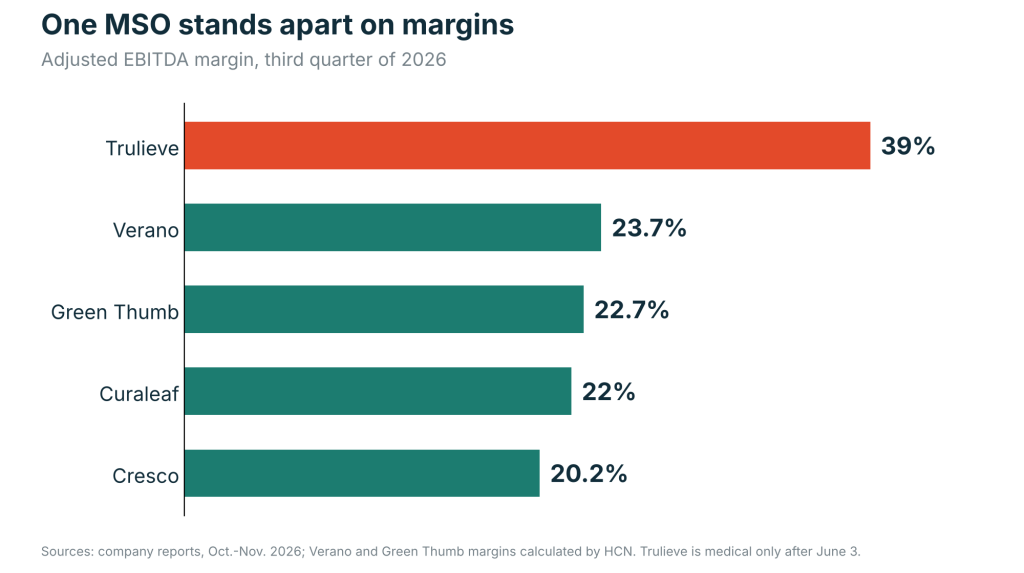
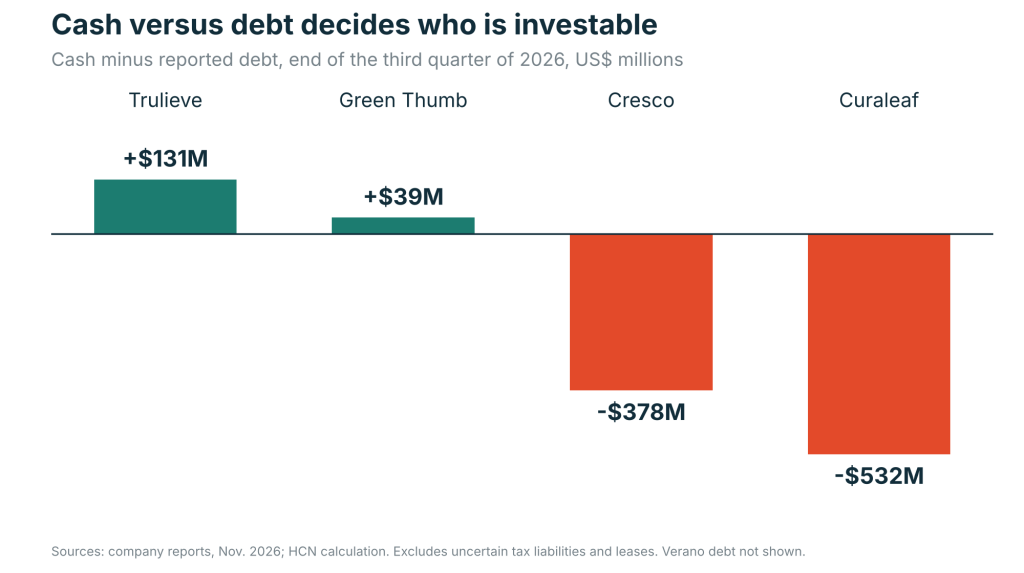
- Trulieve: revenue $230 million, now medical only; adjusted EBITDA margin 39%; free cash flow $45 million; cash $327 million against $196 million of notes.
- Green Thumb: revenue $324 million; adjusted EBITDA margin about 23%; cash $316 million against $277 million of debt; more than $80 million of buybacks this year.
- Verano: revenue $212 million; adjusted EBITDA margin about 24%; operating cash flow $49 million; cash $102 million.
- Curaleaf: revenue $353 million, with international up 28%; adjusted EBITDA margin 22%; cash $105 million against $637 million of debt.
- Cresco: revenue $173 million; adjusted EBITDA margin 20%, down from 24%; cash $76 million against $454 million of debt.
The one line on that list growing fast is Curaleaf’s international business. That is not a coincidence. A company that sells only into U.S. state markets is selling into price wars it cannot win by growing. A three-to-six-times multiple is what investors pay for a business they expect to stand still.
Europe is where the growth is
Germany imported about 201 tonnes of medical Cannabis in 2025, nearly three times the 72.7 tonnes of 2024. [18] Canada shipped 89 tonnes of flower to Germany that year at a declared value of about C$3.18 a gram, while domestic bulk flower sold for about $1.22. [19][20] That is a premium of about 2.6 times for the same plant, paid for EU-GMP certification and a documented supply chain.
Canadian producers are already collecting it. Aurora’s international medical revenue reached a record C$61.4 million in the quarter ended September 30, up 44%, driven mainly by Germany and Poland. [21] U.S. operators are not. The April order opened a legal door to U.S. medical exports, but HCN found no evidence that any U.S. export permit has been issued or any shipment made. [7]
That gap explains the fight for Aurora. Curaleaf opened in August with a bid at a 45% premium, citing Aurora’s “more than 50 tons” of annual EU-GMP capacity, and its own argument was that Canadian producers can ship to European medical markets while U.S. operators cannot. [22] It raised the offer in October to an 86% premium. [23] Organigram topped both on November 3 with an agreed deal worth about C$561 million, a 93% premium to Aurora’s undisturbed price. [24] The market has now put a price on certified European access, and it is high.
Three routes overseas
An MSO that wants an international growth story has three ways to get one.
What else retail investors want
Robinhood listings brought retail investors to the MSOs in May. [6] An international story gives them a reason to buy. They will look for five more things before they hold.
Sources
[1] National Law Review, on the Justice Department’s April 2026 order.
[2] Foley Hoag, Section 280E planning after the order, Sept. 21, 2026.
[3] MJBizDaily, on Trulieve’s NYSE listing, June 2026.
[4] Haywood Securities (Neal Gilmer), via Cantech Letter, Oct. 29, 2026.
[5] Green Thumb Industries, third-quarter 2026 results, Nov. 4, 2026.
[6] MJBizDaily, on U.S. Cannabis stocks trading on Robinhood, May 2026.
[7] Harris Sliwoski, on medical marijuana and DEA import and export permits, 2026.
[8] Morgan Lewis, after the DEA hearing, Sept. 2026.
[9] Cannabis Business Times, on the D.C. Circuit’s denial of a stay, Sept. 9, 2026.
[10] Foley Hoag, Sept. 21, 2026.
[11] Trulieve, third-quarter 2026 results, Nov. 5, 2026.
[12] Curaleaf, third-quarter 2026 results and Form 10-Q, Nov. 3, 2026.
[13] MJBizDaily, on the SAFE Banking Act of 2026, June 2026.
[14] JD Supra, “Rescheduled But Not Listed,” May 14, 2026.
[15] MJBizDaily, July 27, 2026.
[16] Cresco Labs, third-quarter 2026 results, Nov. 6, 2026.
[17] Verano, third-quarter 2026 results, Oct. 29, 2026, via Cantech Letter and Quiver Quantitative.
[18] BfArM import data, via MMJ Daily, Mar. 16, 2026.
[19] Statistics Canada export data, via Cannamonitor, Apr. 8, 2026.
[20] Global Cannabis Exchange, Fall 2026 report, via MMJ Daily, Nov. 3, 2026. Domestic bulk price as reported; currency not stated.
[21] Aurora Cannabis, results for the quarter ended Sept. 30, 2026, Form 6-K, Nov. 5, 2026.
[22] Curaleaf, announcement of its offer for Aurora, Form 8-K, Aug. 11, 2026.
[23] Cannabis Business Times, on Curaleaf’s enhanced proposal, Oct. 2026.
[24] Organigram and Aurora joint announcement, Nov. 3, 2026, via Cannabis Business Times.
[25] MJBizDaily, on Curaleaf’s refinancing, Feb. 2026.
[26] High Ground Medica company materials, November 2026.
[27] Alan Brochstein, Seeking Alpha, Dec. 2025.
[28] Business of Cannabis, on Ayr Wellness, June 3, 2026.
[29] Vicente LLP, on the delay of the federal hemp definition change, Sept. 2026.
[30] Haywood Securities (Neal Gilmer), via Cantech Letter, Nov. 5, 2026.
Market analysis prepared on November 24, 2026. This article is for information only and is not investment advice.
About the Author: HCN News Team

Related Posts