Who Pays While Cannabis Ships to Europe? The Four-Month Cash Gap Behind Every Export.






A Canadian exporter pays its growers up front, then waits about four months for a German buyer to pay. Whoever funds that wait decides how much profit is left.
How an export gets paid for, in plain terms
A Canadian Cannabis export works like this. An exporter buys dried flower from Canadian growers and pays them up front. It then waits for permits in Canada and Germany, ships the flower, has it retested in Germany and sells it to a German pharmacy supplier. Only when that buyer pays does the exporter get its money back.
In High Ground Medica’s model, that wait lasts about 120 days, or four months, and one 100-kilogram shipment ties up about C$158,500 at its peak. [14] Someone has to put up that money for those four months. An exporter that uses only its own cash can afford only a few shipments a year. One that borrows pays interest out of its profit.
Financing the shipment means lending the exporter that money and getting repaid when the European buyer pays. HGM arranges it shipment by shipment: a lender or investor advances money against one approved shipment, the money moves through escrow, and the loan is repaid from the buyer’s payment. [14] The lender earns interest on each four-month cycle, and the exporter can ship more often than its own cash would allow.
Why the wait is getting harder
Selling Cannabis to Europe pays well. Getting paid takes time, and time costs money. As Canadian exports to Germany climb, the producers shipping the most are learning that a profitable export can still drain cash for months.
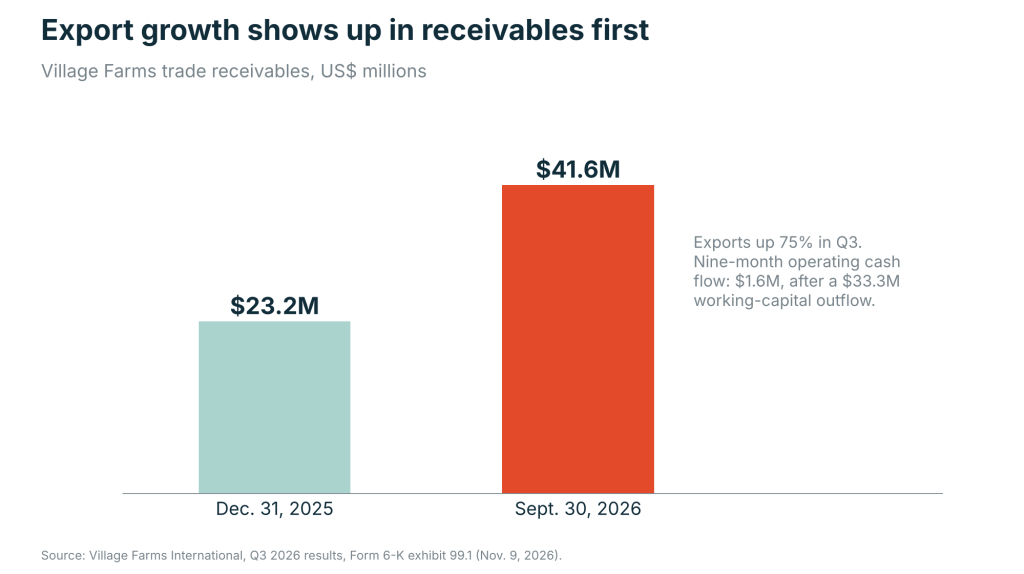
Village Farms shows the pattern. Its exports rose 75% in the third quarter of 2026, to about $20.8 million. [1] Over the same nine months, its trade receivables climbed from $23.2 million to $41.6 million, and its operating cash flow came to only $1.6 million after a $33.3 million outflow for working capital. [1] Its chief financial officer put it plainly in August: “terms on export sales are generally longer than in the Canadian market.” [2]
Village Farms is not alone. Cronos Group’s receivables rose to $44.2 million from $34.1 million at the end of 2025, and its inventory to $54.5 million from about $46.8 million. [3] Organigram’s inventories and biological assets reached C$165.1 million in June, up 33% in nine months. [4] Product waiting to ship, and invoices waiting to be paid, absorb cash that a domestic sale would have returned in weeks.
Where the days go
An export shipment passes through a chain of approvals before it earns a cent. Health Canada’s service standard for an export permit is 30 business days, with a target of meeting it 85% of the time; the only performance figure it has published, for 2020-21, showed 52%. [5] Germany’s Federal Institute for Drugs and Medical Devices (BfArM) needs a separate import permit for each shipment, usually issued in five to seven working days and valid for three months, or six by sea. [6] In 2025, BfArM paused new approvals for a time after imports used up its annual estimate of 122 tonnes. [7]
Then comes the testing. A batch is retested in Europe before a Qualified Person releases it, and flower above 15% THC must come within 10% of its labeled potency or it cannot be sold as labeled. [8] Organigram has said flower spends “weeks” in transit and will “not return the same results” when retested at its destination. [4] Each step adds days, and each day adds interest.

Where the risk sits
Delay is the routine cost. Default and rejection are the rare, expensive ones. In July 2026, customs officers in Düsseldorf burned 632 kilograms of medical Cannabis worth about €122,000. The importer had gone insolvent and could not pay about €23,000 of import VAT. [9] In October, German Cannabis group SynBiotic SE filed for insolvency. [10] Certification can be lost too: Canada’s Mera Cannabis lost its EU-GMP certificate in 2025 after a Berlin inspection found 10 major deficiencies. [11]
Insurers have started to price these risks. Herbal Dispatch obtained export credit insurance from Export Development Canada in June 2026, covering up to C$250,000 per transaction against non-payment by foreign buyers, including in Germany. [12] For an industry once shut out of federal lending, that is a meaningful change. [13]
What the money costs
How an exporter finances the wait decides how much of its margin survives. HCN applied five financing rates to the peak cash exposure in High Ground Medica’s published shipment model: about C$158,500 for a 100-kilogram batch, carried for about 120 days. [14] These are company estimates, and the calculation assumes simple interest on the full exposure.
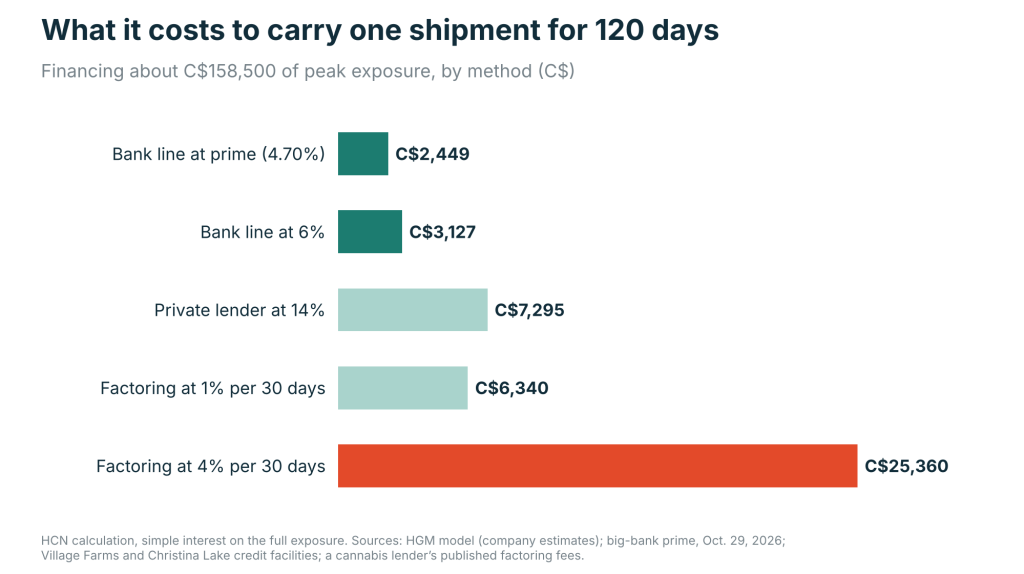
At the big banks’ prime rate of 4.70%, the carry costs about C$2,400. [15] At a rate below 6%, like the one Village Farms reported on its credit facility, it costs about C$3,100. [16] A smaller producer paying 14%, the rate on a revolving facility Christina Lake Cannabis arranged in November, would pay about C$7,300. [17] Factoring, in which a lender advances 70% to 90% of an invoice for a monthly fee, runs from 1% to 4% every 30 days by one Cannabis lender’s own published rates. [18] Over 120 days, that is about C$6,300 to C$25,400.
Against HGM’s estimated contribution of about C$168,800 on the batch, cheap bank credit takes less than 2% of the margin. Expensive factoring takes about 15%. [14] The spread between the best and worst financing equals most of the difference between a good shipment and an ordinary one.
How HGM structures the wait
HGM designed its model around this problem. It finances shipment by shipment. Each advance is tied to an approved shipment, paid out through escrow and repaid when the European customer pays. [14] The company says receivables can be financed at up to 90% of the purchase order, and it names a senior secured lender, a certifier, a credit rater and a German importer as partners. [14] Lenders call this self-liquidating trade finance: the collected invoice retires the loan.
The structure matters for returns as well as risk. At a 120-day cycle, HGM’s capital turns about three times a year. If approvals or testing stretch the cycle to 180 days, it turns about twice, and annual profit on the same capital falls by about a third. [14] For an exporter, days are as valuable as euros.
What to watch
Sources
[1] Village Farms International, results for the quarter ended Sept. 30, 2026, Form 6-K exhibit 99.1, Nov. 9, 2026.
[2] Village Farms Q2 2026 earnings call, August 2026, via The Motley Fool.
[3] Cronos Group, 2026 third-quarter results, Nov. 5, 2026.
[4] Ignite It Cannabis, on Organigram’s European exports, Sept. 8, 2026.
[5] Health Canada, service standard for cannabis import and export permits, page modified June 1, 2026.
[6] German federal administrative portal, BfArM narcotics import authorization, approved Apr. 1, 2025.
[7] Business of Cannabis, Oct. 7, 2025.
[8] Wessling, Pharmazeutische Industrie, September 2022.
[9] Hanf Magazin, on the Düsseldorf customs case, July 2026.
[10] Cannareporter, Oct. 28, 2026.
[11] MFLRC, on Germany’s drying rule and the Mera Cannabis inspection, June 2026.
[12] Herbal Dispatch announcement, May 26, 2026.
[13] Cannabis Business Times, March 2020.
[14] High Ground Medica company materials, November 2026 (company estimates); HCN calculations.
[15] Big-bank prime rate effective Oct. 29, 2026, via Canadian Mortgage Professional.
[16] Village Farms credit facility amendment, Feb. 23, 2026.
[17] Christina Lake Cannabis credit facility announcement, Nov. 3, 2026.
[18] 7 Park Avenue Financial, Cannabis factoring rates, 2026.
Market analysis prepared on November 24, 2026. Company figures are estimates and have not been independently audited. This article is not investment advice.
About the Author: HCN News Team

Related Posts