November Midterms: Cannabis at the Ballot Box






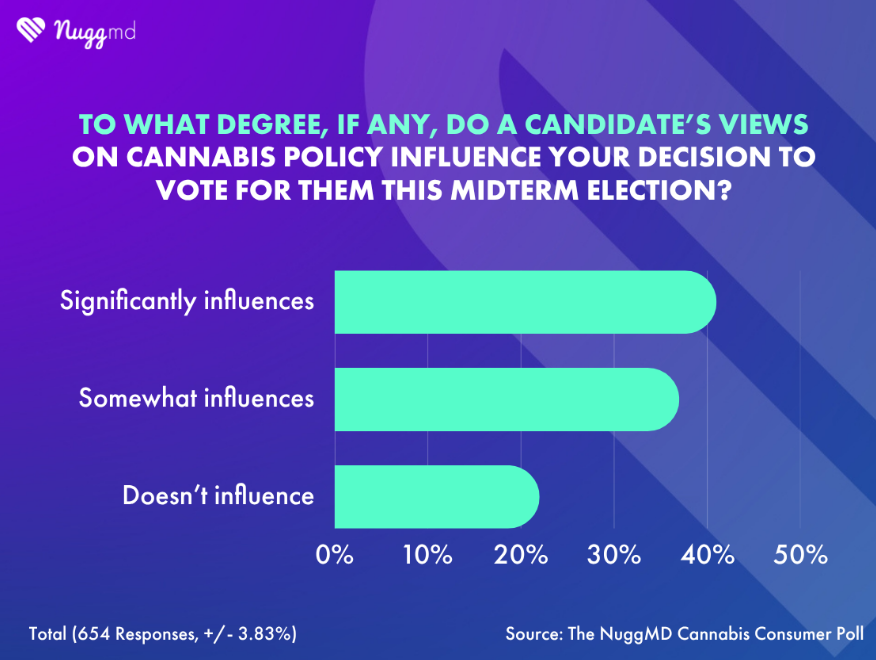
LOS ANGELES – NuggMD conducted the survey, drawing on interviews with 654 Cannabis consumers across states with existing legal markets. Here’s what the numbers say:
- 78% of respondents surveyed stated that a candidate’s position on Cannabis policy would influence their vote this November. Of those, 41% responded that it “significantly” influences their decision.
- 37% answered that it plays “some” role, and
- Only 22% said that the issue will not be a factor at all.
The effect crosses party lines. Republicans (73%) tracked close behind Democrats (83%), and men (76%) behind women (81%), in saying Cannabis policy would shape their vote. That spread deflates any reading of this as a partisan-only concern.
NORML Deputy Director Paul Armentano framed the stakes plainly in a statement accompanying the release: “Reforming America’s failed marijuana prohibition laws enjoys bipartisan support among voters,” he said and added that candidates who ignore that reality do so at their own political peril.
That warning arrives against a backdrop of visible federal inaction. A separate NuggMD poll found that Cannabis consumers’ approval of the Trump administration’s actions on Cannabis has dropped to 29%, down from 73% just two quarters ago, as federal rescheduling remains stalled in a still-active administrative hearing.
Two direct ballot fights add further texture to the midterm picture. In Massachusetts, Question 8, financed almost entirely by out-of-state prohibitionist funding, would repeal voter-approved laws governing home cultivation and licensed retail Cannabis sales. Polling places opposition above two-thirds of the state’s likely voters, and more than 50 elected officials [including U.S. Senators Warren and Markey, Governor Healey, and Boston Mayor Wu] have publicly urged a no vote.
In Idaho, HJR 4 would amend the state constitution to strip citizens of any future right to put Cannabis reform on the ballot through the initiative process, a measure NORML called flatly anti-democratic in a recent op-ed. In Houston, The Houston Freedom Act asks voters to direct the city’s police department to treat low-level adult-use Cannabis possession arrests as its lowest enforcement priority.
The NuggMD data and this November’s ballot activity share a clear direction. The Cannabis voter is a cross-partisan constituency driven by compound frustrations: with federal delay, with legal-market fragility, and with officials who have had the polling data for years and largely kept it at arm’s length. For the industry, sustained pressure of this kind is exactly the upstream force that has historically shifted regulatory frameworks. The 2026 midterms will show how much of it has converted into organized political will.
About the Author: HCN News Team

Related Posts