Earnings Season: Cannabis Operators Deliver a Different Kind of Q2 2026







LOS ANGELES – The Cannabis industry wraps up its second-quarter earnings, and the aggregate picture carries a theme that would have been harder to locate a few years ago. Operators are making money. Profitability, not revenue scale, is the number that commands attention now. Cannamonitor Decide has compiled every result released through mid-August, spanning operators from Tallahassee to Tel Aviv.
US MSOs: Margins Win the Quarter
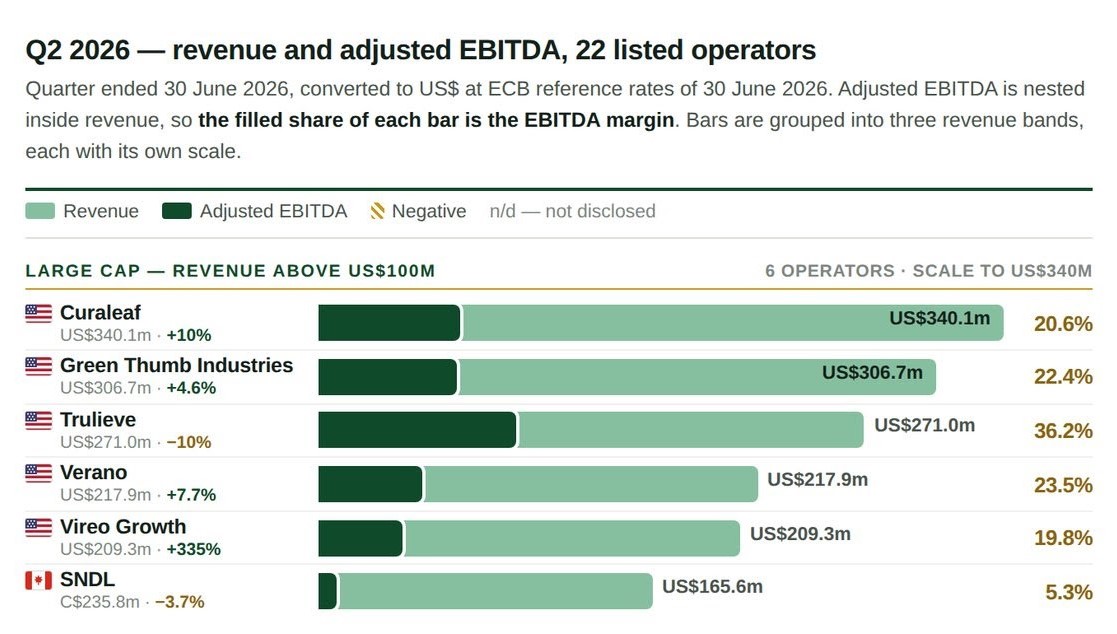
Among American multi-state Cannabis operators, the Q2 earnings season showed a sector holding profitability together even as top-line growth slowed. Curaleaf reported US$340 million in net revenue, up 10% year-over-year, with a 50% gross margin and US$70 million in adjusted EBITDA at a 21% margin. Green Thumb Industries posted US$307 million [approx. 5% growth] with US$84 million in normalized EBITDA at a 28% margin, though same-store sales fell 1%, partly reflecting industry-wide pricing pressure.
Verano Holdings recorded US$218 million in revenue, up 8% year-over-year, while adjusted EBITDA declined to US$51 million from the prior-year period. The company completed a 1-for-5 reverse stock split during the quarter, a preparatory step toward a prospective U.S. exchange listing. Vireo Growth reported revenue of US$209.3 million for the quarter, up 335% year-over-year from $48.1 million in Q2 2025, driven by closed acquisitions.
Trulieve, the first U.S. plant-touching Cannabis operator to list on the NYSE, had the most structurally layered quarter of the group. Revenue declined 10% to US$271 million, primarily reflecting the June deconsolidation of its adult-use Harvest operations, yet adjusted EBITDA reached US$98 million at a 36% margin, the highest result in the US peer set.
The Curaleaf-Aurora Bid
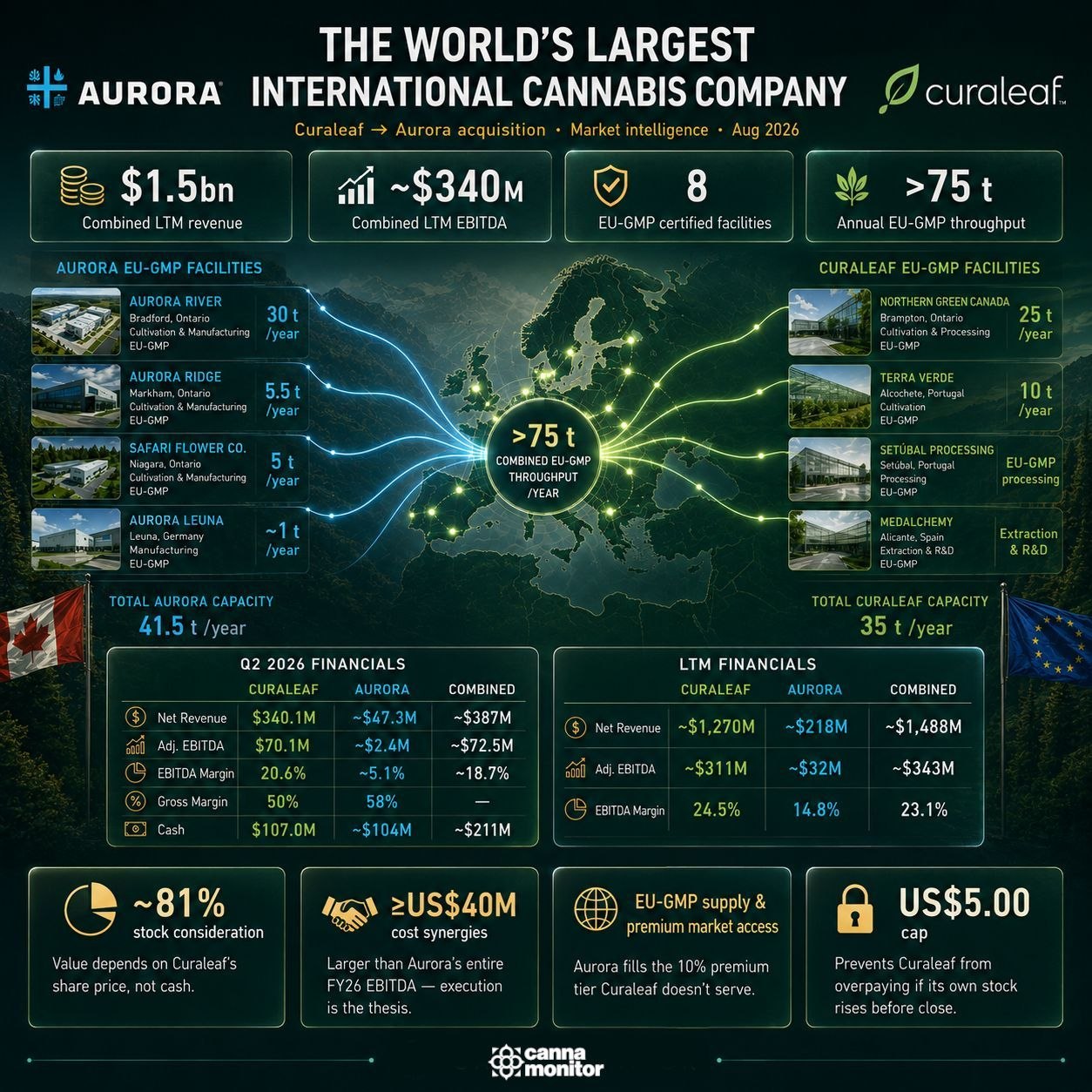
Curaleaf’s Q2 results were quickly overtaken by a separate announcement. On August 11, the company publicly disclosed an unsolicited takeover bid for Aurora Cannabis, offering US$4.00 per share, a 45% premium to Aurora’s 30-day volume-weighted average price, for a total consideration of approx. US$272 million. A combined entity, Curaleaf said, would operate across 17 countries with trailing 12-month revenue exceeding US$1.5 billion and pro-forma adjusted EBITDA approaching US$350 million. The company projects at least US$40 million in annual cost savings through supply chain integration, citing Aurora’s 50-plus tons of annual EU-GMP cultivation capacity as the primary supply-side rationale. Curaleaf chairman and CEO Boris Jordan had initiated contact with Aurora’s leadership in late June. Aurora declined to engage. By now, no formal negotiations had begun.
Canadian Producers Pull Ahead
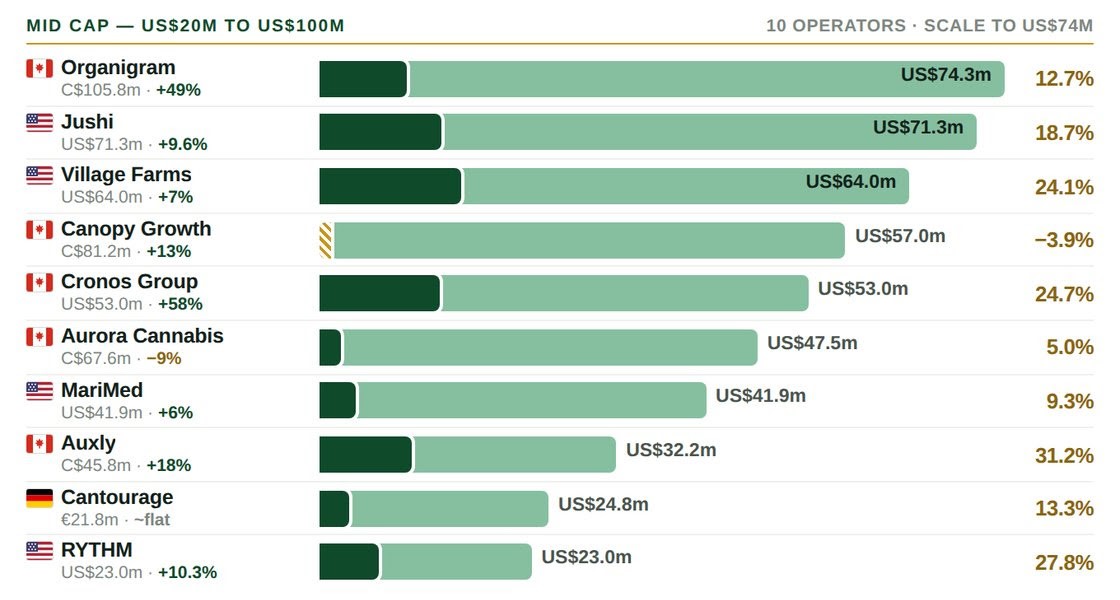
The performance gap between US and Canadian operators was wider than many observers expected. Cronos Group reported a 58% year-over-year increase to C$53 million in net revenue; its tenth consecutive record quarter in Israel, driven by PEACE NATURALS flower demand in the Israeli medical market and Germany. Gross margin reached 54%, and the company swung to net income of US$35.7 million from a US$38.5 million net loss in the same period last year.
Organigram grew revenue 49% [contribution from the April acquisition of Germany’s Sanity Group], Rubicon Organics posted a record quarter, Auxly added 18%, and Canopy contributed 13% growth. International medical exposure and lighter excise structures are creating a differential the US domestic market cannot currently match.

Europe’s Two-Track Quarter
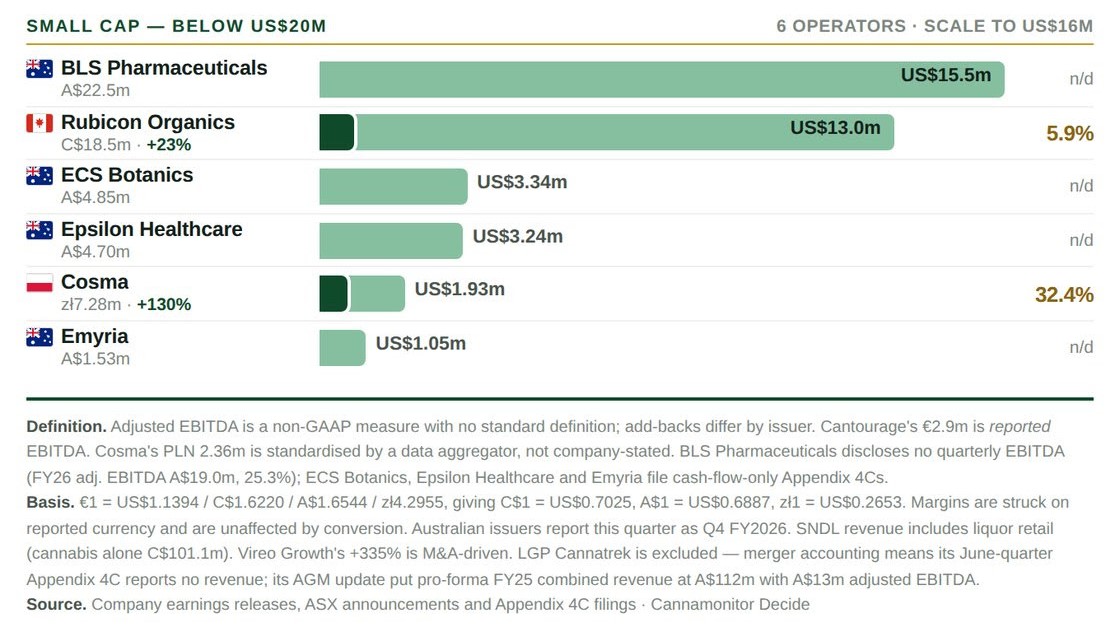
Cantourage Group SE traded revenue scale for earnings quality. Q2 net revenue fell 22% year-over-year to €21.8 million, while EBITDA rose 45% to €2.9 million, lifting the EBITDA margin to 13.1%. UK and Poland drove the profitability gain. Poland’s Cosma S.A. returned to profit, reporting PLN 7.3 million in revenue.
Synbiotic SE went the other direction. Two CBD-facing subsidiaries [Solidmind, operator of the Hempamed brand, and Lean Labs Pharma] filed for insolvency in late July in Münster, sending Synbiotic shares down roughly 30%. CEO Daniel Kruse attributed the filings to a sharp demand contraction for CBD and hemp products starting in March 2026, compounded by ongoing regulatory ambiguity in that segment. The episode reinforces a distinction hardening across Europe. Medical-regulated Cannabis and consumer CBD are separate commercial businesses, with materially different capital and risk profiles.
HCN Insight
The Q2 results, read together, describe a market that has stopped reaching for revenue scale and started concentrating on cash. US operators are generating real margin on flat or declining revenue – a posture that reflects both market maturation and the pricing pressure that has persisted across state markets for several years.
Canadian producers’ international medical exposure, particularly in Germany and Israel, is delivering a growth rate the US domestic market cannot currently replicate, and the structural advantages of operating outside excise-heavy Canadian frameworks are clearly showing up in gross margins.
The Curaleaf-Aurora bid, if it proceeds to close, would constitute one of the most notable cross-border transactions in Cannabis industry history, testing the premise that supply-chain consolidation across different regulatory jurisdictions can generate sufficient returns to justify the acquisition premium.
In Europe, the divergence between medical-focused operators building toward sustained profitability and CBD-adjacent businesses absorbing unresolved regulatory uncertainty is no longer marginal. It is a defining split in how the region’s Cannabis economy is taking shape. Capital moving through this sector has more quantitative clarity available today than at any prior point in its development. The Q2 2026 scoreboard gives it good reason to use that clarity carefully.
About the Author: HCN News Team

Related Posts