
What’s in a Jar? For Cannabis Concentrate Brands, Quite a Lot
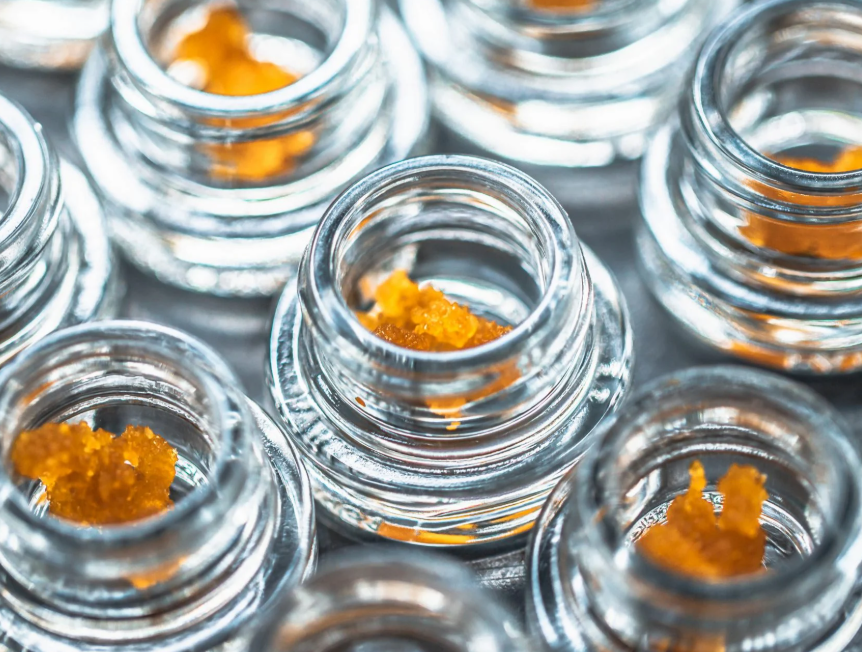






LOS ANGELES – The packaging debate in Cannabis manufacturing rarely makes headlines. But the choice between glass and plastic for concentrate products is one that shapes what a brand becomes and what it can prove.
The global Cannabis concentrate market, valued at roughly $1.6 billion in 2025, is projected to reach $9 billion by 2036 at a CAGR of 17%. As live resin, rosin, and distillate continue to capture shelf space across legal markets, manufacturers are confronting a question that cuts across chemistry, regulation, cost structure, and brand identity: what does the container actually do to the product inside it?
The Chemistry Case
The answer, it turns out, is more consequential than most operators initially budget for. Cannabinoids and terpenes are susceptible to light, oxygen, heat, and time. Recent laboratory testing has shown that terpene profiles in samples stored under standard LED lighting can diminish by 15% to 20% within 90 days, whereas dark-stored controls maintain over 95% of their original profile.
This is where material chemistry enters the operating equation. Cannabis concentrates are oil-based and can interact with certain plastics, particularly under heat or extended storage. Glass is chemically inert and does not leach into the product. For terpene-forward SKUs [the products where flavor profile and potency are the primary value proposition] the container’s chemical neutrality is a measurable quality variable, not just a marketing preference.
Amber and UV-coated glass performs differently than clear containers of either material. Plastic can absorb heat and allow light to penetrate, accelerating degradation. In high-humidity or brightly lit retail settings, plastic jars often fail to protect the product’s texture, color, and potency.
The Compliance Dimension
Regulatory requirements add another layer. Cannabis packaging compliance requirements vary by jurisdiction, but common themes include child-resistant certification, tamper-evidence, and opaque packaging mandates. Both glass and plastic can meet most requirements, though implementation differs.
Some states are moving toward stricter material standards. Vermont’s Cannabis Control Board has compiled a non-exhaustive list of plastic-free packaging options to help licensees find compliant solutions, reflecting a broader regulatory push in certain jurisdictions toward reducing plastic use in Cannabis packaging. Manufacturers operating across multiple state markets must track these variances proactively – a packaging spec that clears Colorado may require adjustment before entering the Vermont or New York market.
The Cost Calculation
The standard assumption [that plastic is cheaper] holds up at the invoice level, but not always at the product or consumer end. Product loss, reduced potency, and poor shelf appeal can damage a brand’s bottom line in ways that basic unit pricing doesn’t capture. Even a lower-cost glass concentrate jar can offer better protection and brand value, contributing to stronger customer retention and fewer quality complaints.
For high-velocity, entry-tier concentrates with rapid retail turnover, the material difference may be operationally negligible. For premium extract lines where terpene accuracy and batch consistency are core to the value proposition, the cost-of-degradation argument tends to favor glass over any production-cycle savings from plastic.
The Market Signal
Consumer and regulatory trends are reinforcing this shift. The global Cannabis packaging market is projected to grow from $7.37 billion in 2026 to $21.55 billion by 2034, with a notable trend toward sustainable, premium, and compliant packaging. Glass retains a premium niche among medical users who associate it with pharmaceutical purity, while metal tins are gaining ground in concentrates for light-protected storage.
At the same time, biopolymers are registering the fastest growth rate in Cannabis packaging materials, driven by hemp-based resins and corn-starch PLA formulations that comply with child-resistant requirements. The plastic vs. glass binary is slowly expanding into a three-way conversation that includes bio-based materials, though those options remain early-stage for most concentrate producers.
The Strategic Read
Experienced operators match material to product tier and customer base. Premium rosin or sauce brands often select glass to preserve quality and reinforce luxury appeal. Mass-market or value concentrates lean toward plastic for efficiency and affordability. Hybrid approaches appear in some portfolios, using glass for flagship items and plastic for supporting SKUs.
For Cannabis CPG manufacturers, the packaging decision is ultimately a product integrity decision wearing a procurement coat. The market rewarding terpene accuracy, verifiable potency, and environmental accountability is the same market paying premium prices for high-quality extracts. Glass doesn’t automatically deliver on any of those promises, but it removes several obstacles to doing so.
About the Author: HCN News Team

Related Posts