The ROI Investors Are Ignoring Within the Cannabis Industry






LOS ANGELES- Industrial hemp has more ROI potential than the medicinal and intoxicating side for a simple reason: industrial hemp is a raw material that can be swapped into enormous existing markets, while medicinal products are constrained by a small set of delivery formats and a much higher regulatory playing field.
On the medicinal side, products fall into three lanes: ingestion, topical, or inhalation. That structure limits how many categories you can realistically expand into, and it keeps the category tied to shifting rules, enforcement priorities, labeling requirements, and the uncertainty around what will still be permitted or commercially viable as regulations tighten. It’s also why we see so many copycat products repackaging the wheel.
The argument over THC levels, cannabinoid ethics, and false health alarm bells will never end.
Industrial hemp is different.
It is a fiber and grain platform that can feed tens of thousands of existing end-use products across multiple industries. That means the growth ceiling is not based on gaining new consumers or creating new habits—it is about converting demand that is already there.
That difference is where ROI shows up.
Industrial hemp ROI is based on replacing, not creating.
Replacement markets are investor-friendly because demand already exists, budgets already exist, and buying behavior is already locked in. The question becomes performance, price, and supply chain reliability—not consumer education.
Toilet paper is the easiest example because it is universal and repeat-purchase. The global toilet paper market is commonly estimated in the mid-$50B range annually. Capturing even a small slice of that spend is meaningful, and the adoption mechanism is straightforward: if the product performs and the economics work, customers do not need to change habits—they just choose a different roll.
Textiles and apparel make the point even more aggressively. The global apparel market is often estimated around $1.7T per year. Industrial hemp fiber does not need to create new clothing consumption. People already buy t-shirts, denim, socks, uniforms, and home textiles at massive volume. The value is in swapping the raw material to meet sustainability requirements while holding durability and comfort standards.
Packaging is another “massive market, simple swap” category. Global packaging is commonly estimated around $1T-plus annually. Packaging decisions are increasingly driven by procurement requirements, recycling constraints, and brand risk. A fiber input that can lower environmental impact and strengthen traceability can win because packaging buyers are already being forced to justify their material choices.
Then there are the less glamorous categories that also have built-in demand because they are routine purchases: kitty litter, animal bedding, and agricultural absorbents. The cat litter market alone is often estimated in the mid-teens of billions globally. Horse bedding and livestock absorbents are not headline categories, but they are steady, recurring spend with buyers who care about price, performance, and handling.
These are the kinds of markets that do not require trend cycles to grow.
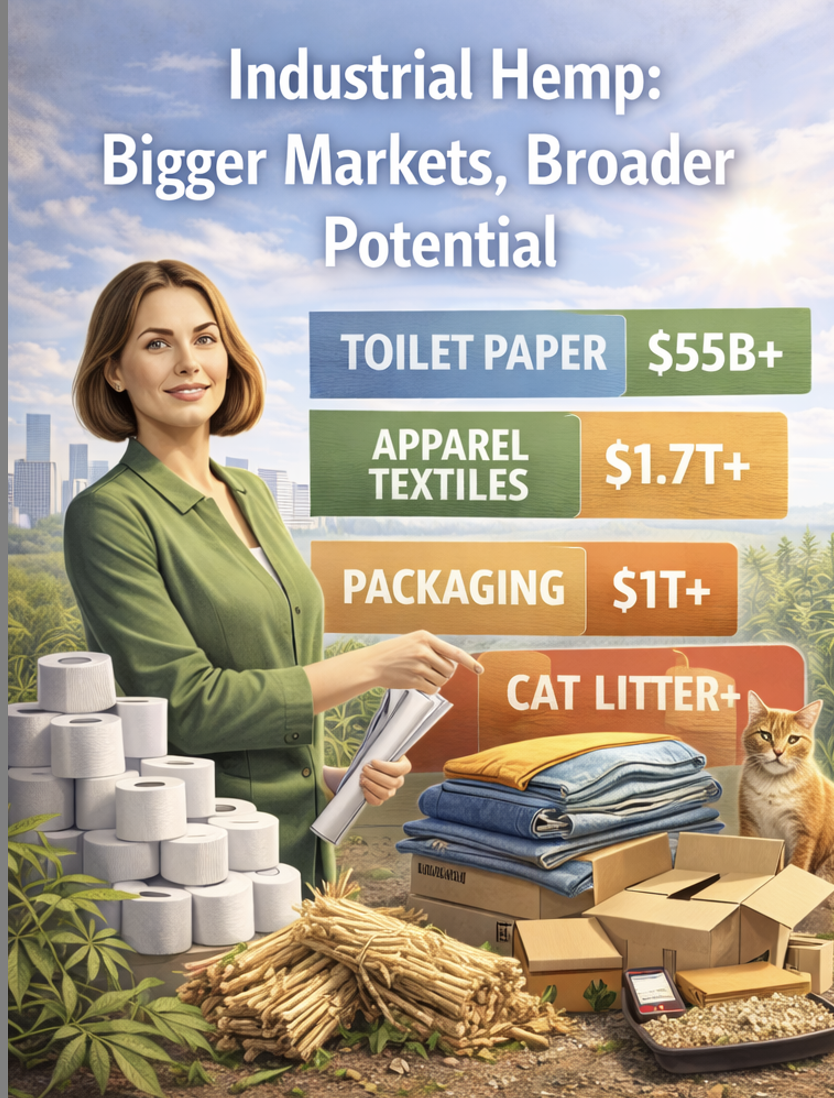
The key point across all of these: nobody is talking about banning toilet paper, t-shirts, kitty litter, or horse bedding. These categories are not politically fragile. They are not dependent on a single regulatory interpretation. They are simply markets with huge, stable demand that can be upgraded by changing only the input.
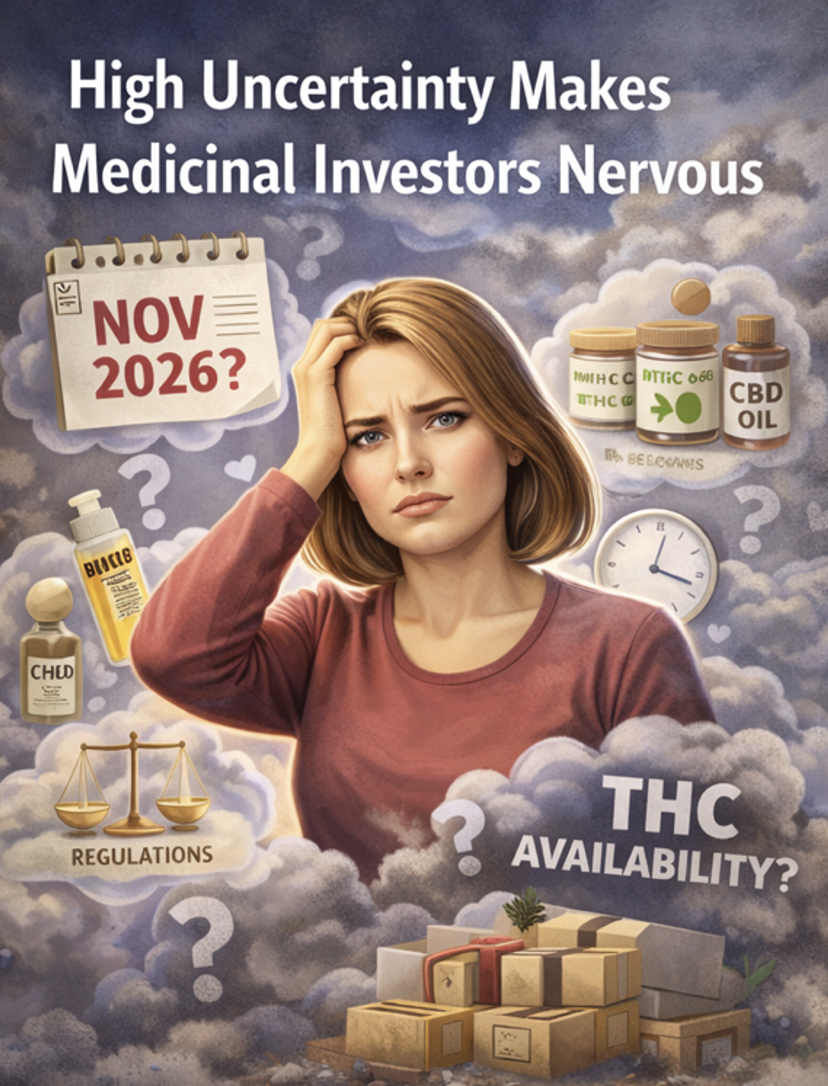
Regulatory uncertainty is concentrated on the medicinal and intoxicating side.

The Author: Erica Halverson
Investors do not just invest in upside—they invest in how predictable the rules of the game are.
Right now, there is a ticking clock for part of the industry: November 2026 is a known pivot point for how “hemp” is defined and enforced in ways that affect many intoxicating hemp-derived products. Even for operators who believe they will adapt, uncertainty still raises the cost of capital and makes distribution partners more cautious.
Add the separate uncertainty around THC availability and federal rescheduling timelines. Those may move, but investors cannot plan a five-year outcome around “if and when.” That dynamic does not make medicinal products un-investable—but it does change the risk premium and narrows which strategies have a clean path.
Industrial hemp is not immune to challenges. Supply chains must be built, specifications must be consistent, and scaling manufacturing always has execution risk. But the category is not fighting the same product-legality risk—and that difference matters when modeling downside scenarios.
Industrial hemp has a broader landscape of possibilities, which compounds returns.
It is not a single-product bet. It is a platform input with multiple end markets, creating optionality investors care about.
Optionality looks like this:
- Start with one high-frequency category (toilet paper)
- Build repeatable supply and quality specs
- Expand into adjacent fiber categories (towels, wipes, packaging, textiles, non-wovens)
- Monetize fiber and grain outputs across multiple buyers over time
That is a compounding story because progress in one category de-risks the next. It also creates multiple paths to revenue rather than a single narrow channel.
This is why industrial hemp can produce a higher ROI profile than the medicinal lane: it has a larger surface area for value creation. The number of potential end products is measured in the tens of thousands—and it continues to grow as material science and sustainability requirements evolve.
The industrial hemp ROI story in one sentence:
Predictable demand + massive existing markets + material substitution = a cleaner path to scale than a category whose rules may shift at any time.
Copyright 2026 ©Highly Capitalized Network and Erica Halverson. All rights reserved. Highly Capitalized Network thanks Erica Halverson for her opinions in this article.
About the Author: Erica Halverson
Erica Halverson is the Founder & CEO of TINY e TOILET PAPER, where she is pioneering the first 100% industrial hemp toilet paper designed to meet true ESG standards. A repeat founder and seasoned CPG executive, she is also a patent-pending inventor of the first pH-balanced infused toilet paper tailored for men and women.
A published industrial hemp educator and outspoken advocate, Erica is leading a pilot with a major global manufacturer and is currently fundraising to scale production. Her mission is simple: redefine sustainable hygiene and replace trees with industrial hemp — one roll at a time.
Follow & Stay Tuned
Follow and stay tuned for more from Highly Capitalized Network–HCN—your front-row seat to business & finance news from the global world of cannabis. Subscribe here: highlycapitalized.com.
About the Author: HCN News Team

Related Posts