Opinion: The Timing Has Never Been Better for Industrial Hemp






LOS ANGELES- A few years ago, ‘sustainable’ was a buzzword. Using the word ‘sustainable’ in marketing messages was a clever way for a company or brand appear to be living in the now, without having to do much to prove it.
Times are changing.
Governments are tightening purchasing standards. Corporations are being required to measure what they buy, not just what they say. Consumers who care about the climate are getting more skeptical and more informed, especially about everyday products they’ve been using for years without a thought.
That shift is putting pressure on the materials we use. It is also exposing how much of the “eco” consumer goods market has been built on words, not actions. Paper is a perfect example.
Most households and businesses still rely on paper products made from trees. The better alternative that took off in recent years was bamboo, especially in toilet paper. Bamboo became the default because the pitch is easy: it doesn’t use trees and grows faster, which means sustainable….right?
Wrong. In reality, sustainability is never that simple. How a crop is grown, where it is grown, what inputs are used, how land is managed, how it is processed, and how far it travels all matter. Bamboo can be responsibly cultivated, but it is often sourced through long supply chains that are difficult for buyers to verify end-to-end. In some regions it can also create land-management challenges because of how aggressively it spreads if not carefully controlled. Bamboo isn’t “bad.” It’s just not as ‘clean’ as is often marketed as.
As standards tighten, products can’t just say they’re sustainable, they actually have to BE sustainable.
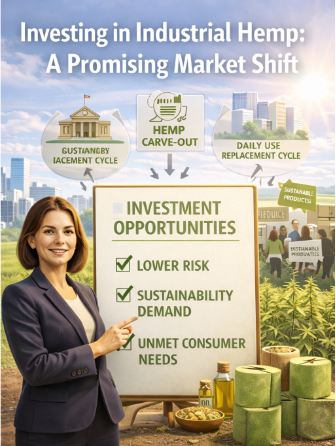
This is where industrial hemp becomes a very different opportunity.
 The author: Erica Halverson: CEO of TINY e TOILET PAPER
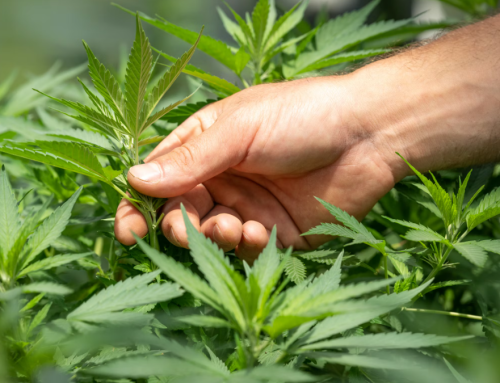
Industrial hemp is not a single-purpose crop. It is a multi-output platform. The fiber can be used for paper, textiles, insulation, nonwovens, composites, and packaging. The hurd has uses in construction materials and animal bedding. The grain and oil create additional markets. That breadth matters because it makes a supply chain more resilient. When an input can serve multiple industries, it is easier to build stable demand and justify scaling processing capacity without betting everything on one category.
It also fits more naturally into modern agriculture. Industrial hemp is an annual crop that can be rotated.
Farmers can integrate it into existing systems without committing land for years the way they might with some perennial crops. That makes supply planning more practical, especially as growers respond to shifting commodity prices and changing climate conditions.
This is what makes this plant so much more viable than any other. It’s also what makes this part of the cannabis plant family so much different than the medicinal side.
The missing piece for industrial hemp, historically, has been a mainstream product that creates steady, predictable demand. Many industrial hemp applications are real, but some are niche, some depend on slow-moving procurement cycles, and some are tied to markets that can take years to develop.
Paper, textiles, plastics, are all examples of repeat purchase materials featuring products with consistent demand. Paper packaging, t-shirts, and plastic ketchup bottles are great examples of this. And no one is debating whether or not ketchup should be banned. All of this leads to one conclusion: the time is now for industrial hemp.
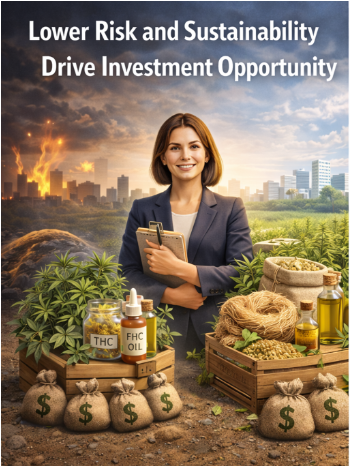
Sustainability standards are becoming more demanding, and the market is getting less patient with products that rely on vague claims. Paper goods are a daily-use category where the impact is real and the opportunity to improve is immediate. Bamboo will continue to be part of the conversation, but the market is starting to look past quick fixes and toward supply chains that can hold up under scrutiny.
Industrial hemp can do that, and it can do it across many product categories. As sustainability becomes not just a buzz word but a way of life, it will get harder and harder to ignore the plant and all its capabilities.
Copyright 2026 ©Highly Capitalized Network and Erica Halverson. All rights reserved. Highly Capitalized Network thanks Erica Halverson for her opinions in this article.
Erica Halverson is the Founder & CEO of TINY e TOILET PAPER, where she is pioneering the first 100% industrial hemp toilet paper designed to meet true ESG standards. A repeat founder and seasoned CPG executive, she is also a patent-pending inventor of the first pH-balanced infused toilet paper tailored for men and women.
A published industrial hemp educator and outspoken advocate, Erica is leading a pilot with a major global manufacturer and is currently fundraising to scale production. Her mission is simple: redefine sustainable hygiene and replace trees with industrial hemp — one roll at a time.
About the Author: HCN News Team

Related Posts