Indiana Republicans Propose Statewide Oversight for Craft Hemp Market






INDIANAPOLIS – Three Republican members of the Indiana House introduced legislation this week to impose a structured permitting system on the sale and distribution of craft hemp products, a category that includes flower, beverages and extracts with low levels of THC. The measure, House Bill 1130, aims to centralize regulation under the Indiana Alcohol and Tobacco Commission and address gaps left by recent federal adjustments to hemp definitions.
The bill’s sponsors [Representatives Steve Bartels, Jake Teshka and Heath VanNatter] filed the proposal on January 5, sending it to the House Public Policy Committee for review. If approved, it would activate on July 1, 2026, just months before a federal prohibition on most intoxicating hemp derivatives takes hold in November. That national shift, embedded in last year’s agriculture spending package, narrows the legal threshold for hemp to products with no more than 0.3% total THC, effectively sidelining delta-8 and similar isomers that have fueled Indiana’s $1 billion hemp sector.
Under HB 1130, retailers would need a $1,000 annual permit per location, capped at 20,000 statewide to prevent oversaturation. Distributors and manufacturers face $5,000 fees, with all operators required to maintain records, conduct potency, contaminant testing, and adhere to uniform packaging standards that disclose THC content clearly. Sales to anyone under 21 would be barred outright, with penalties escalating from misdemeanors for initial breaches to felonies in cases involving minors’ harm or repeated infractions. Locations within 1,000 feet of K-12 schools would be off-limits for new outlets, though grandfathering applies to businesses active before this year.
This framework echoes elements of Senate Bill 478, which cleared the General Assembly in April 2025 to govern craft hemp flower specifically, setting precedents for age gates and advertising curbs. Yet HB 1130 broadens the scope to encompass beverages and extracts, potentially stabilizing a market rattled by the impending federal cutoff. State chemists already test raw hemp for compliance, but the bill would extend scrutiny to finished goods, a step industry observers see as essential for credibility amid enforcement challenges at the federal level.
From a business standpoint, the permit fees could generate upward of $25 million annually at full capacity, based on the retail cap alone – revenue that might offset enforcement costs estimated at $2 million in the bill’s fiscal outline. Critics, however, question whether the 20,000-permit limit stifles expansion in a state where hemp cultivation spans thousands of acres. Compared to neighbors like Ohio, which uncapped its hemp retail licenses after 2023 reforms, Indiana’s approach risks constraining operators who have invested heavily in delta-8 lines now facing obsolescence.
Hemp stakeholders have voiced measured support for regulation but stress the need for swift passage to avert a “culture of chaos” with federal agents potentially prioritizing high-volume states over Indiana’s fragmented setup. No formal endorsements have surfaced since filing, though the timing aligns with broader congressional signals, including the recent abandonment of efforts to stall Cannabis rescheduling.
For Indiana’s hemp players, HB 1130 represents a calculated bid to carve out a compliant niche before federal rules rewrite the playbook. Whether it clears committee and garners bipartisan buy-in will determine if the state transitions smoothly to a more formalized trade, or… watches jobs and output evaporate by year’s end. As the session unfolds, operators would do well to audit inventories against the bill’s specs, positioning for what could become the new standard in Hoosier hemp.
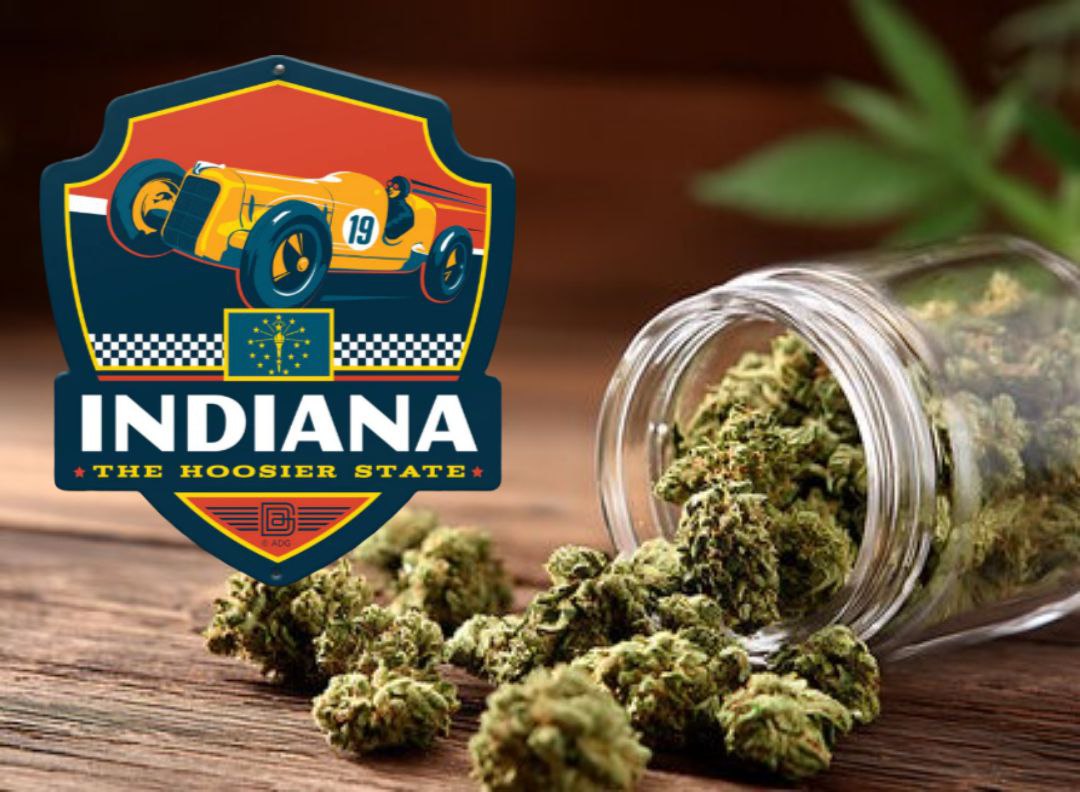
Photo: Getty Images/Indiana State’s emblem courtesy of Anderson Design Group
About the Author: HCN News Team

Related Posts