Green Wednesday 2026: Is your Dispensary Ready to Outperform Black Friday?
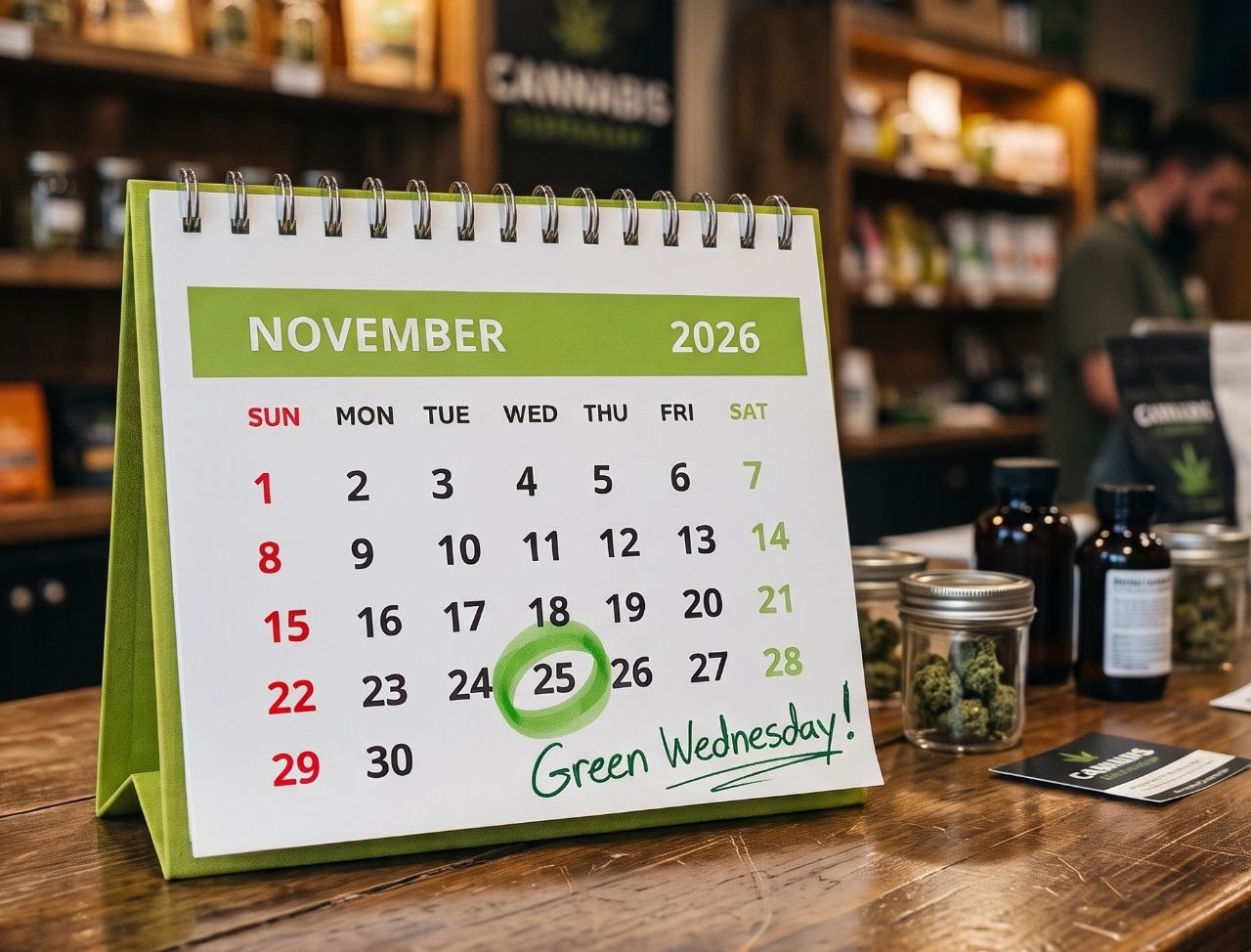






LOS ANGELES – For Cannabis operators across the United States, the holiday season kicks off not with Black Friday, but with Green Wednesday. Falling on November 25 in 2026, the day before Thanksgiving has cemented itself as the second largest Cannabis sales day of the year, trailing only behind 4/20.
As consumers prepare to travel, host family, or simply relax over the long weekend, dispensaries experience a massive influx of foot traffic and online orders. However, the 2026 market presents a unique set of challenges and opportunities. With wholesale prices dropping and consumer purchasing habits shifting, operators must balance the desire for high sales volume with the critical need for margin preservation. Explore the details, data, marketing strategies and operational tactics Cannabis retailers need to win on Green Wednesday 2026.
Overview
Once a niche industry secret, Green Wednesday has become a mainstream retail event. In 2025, Green Wednesday generated $114 million in sales, representing a 1.7x multiplier over an average day. While 4/20 remains the undisputed champion at $135.3 million [2.0x an average day], Green Wednesday has comfortably outpaced both Black Friday and the days leading up to July 4th and Labor Day.
The defining characteristic of Green Wednesday is stock-up behavior. Whether customers are preparing to share with relatives, supplying the classic “cousin walk,” or purchasing products to help cope with holiday stress, the intent is clear: buy enough to last the long weekend.
Furthermore, digital engagement sees a massive spike. Historical data indicates that on Green Wednesday, single-day online sales revenue for dispensaries can surge by 85%, while the number of online shoppers increases by 95%. Coupled with a 22% increase in overall online conversion rates, it is evident that a strong digital menu and e-commerce presence is non-negotiable.
However, the macroeconomic landscape of Cannabis in 2026 requires operators to be more strategic than ever. Across the country, Americans are buying more Cannabis but paying less for it. Over the 12 months ending in September 2026, unit sales grew by 4.8%, and transaction counts grew by 5.8%, yet dollar growth remained modest due to steadily falling prices. In maturing markets, this means dispensaries must move significantly more products just to maintain the same revenue levels.
Category Trends
Understanding product velocity is crucial for inventory planning. While flower remains the largest overall category, accounting for 39.1% of all sales [$9.6 billion], consumer preferences shift noticeably during the Thanksgiving holiday.
The most dramatic surges happen in discreet, shareable, and travel-friendly categories. Data from previous years shows that edible orders jump by 81% on Green Wednesday compared to an average November Wednesday. Vape pens follow closely with a 52% increase, and flower sees a 48% boost. Pre-rolls are also a massive driver. They are currently the fastest-growing major category in the industry, up 13% year-over-year.
When analyzing dispensary baskets, flower appears in 37.3% of all transactions, pre-rolls in 32.7%, vapor pens in 30%, and edibles in 16.9%. Since edibles and vapes have the most significant Green Wednesday lift, operators should lean heavily into these categories when planning their inventory and promotions. Inventory purchased for Green Wednesday in these categories also tends to sell well through the rest of the holiday season, mitigating the risk of dead stock.
The Margin Trap
Perhaps the most dangerous pitfall for Cannabis operators on Green Wednesday is the race to the bottom with pricing. While generating a record-breaking day in top-line revenue looks great on paper, deep storewide discounts can destroy profitability.
In recent years, the average discount depth during the Green Wednesday period reached 28.65% – the deepest of any holiday period that year. To put this into perspective, if an item costs a retailer $20 and usually sells for $40 (a 50% margin), applying a 28.65% discount drops the sale price to $28.54. Instead of earning $20 in gross profit, the dispensary earns just $8.54. To make the same amount of gross profit as a normal day, the store would need to sell 2.3x as many units.
The State of New York provided a stark example of this margin trap in 2025. During Green Wednesday, New York dispensaries saw sales revenue rise by 24.5% year-over-year, but the actual units sold skyrocketed by 56.1%. This dynamic translates to roughly 20% less revenue per unit than the previous year.
To protect margins, operators must shift their focus from raw sales volume to increasing the Average Order Value (AOV) and gross profit per basket. A flat 30% discount across the entire store gives away margin on items that customers were already planning to buy. Instead, retailers should judge the success of the event by the gross profit generated over the entire Thanksgiving week, rather than just the revenue booked on Wednesday.
Strategic Promotions & Marketing
To avoid giving away unnecessary margin, dispensaries must deploy targeted, intelligent promotions that incentivize larger baskets.
Tiered discounts are one of the most effective ways to raise basket size without aggressively discounting every single item. By setting spending thresholds, you reward customers for buying more. A standard structure might look like:
- Spend $50+, Receive 5% off.
- Spend $100+, Receive 10% off.
- Spend $200+, Receive 15% off plus a promotional item for a penny.
Curated mix-and-match bundling simplifies the decision-making process for consumers facing decision fatigue while simultaneously moving more units per transaction. Operators should build bundles combining popular high-traffic SKUs with slower-moving items, or pair selected edibles and pre-roll multipacks at a fixed price. A moderate discount on a multi-product bundle always beats a deep discount on a single item.
Spread the demand. Consumer behavior is shifting, with many shoppers preferring to buy one to two days before the actual holiday to avoid long lines. Dispensaries should launch their deals early, starting on Monday, November 23, to capture early traffic and spread demand evenly across the week.
Flash sales and loyalty exclusives create a sense of urgency that can drive off-peak traffic. Dispensaries can launch limited-time flash sales during slower afternoon hours, focusing on a specific product category with a visible start and end time. Additionally, offering early access or exclusive member-only pricing to your loyalty program members can drive retention and make your best customers feel valued.
Vendor brand partnerships help fund holiday discounts, but the mechanics must be clearly defined in writing to avoid margin leaks. Operators must agree with vendors on what share of the discount the brand will fund, which specific SKUs are eligible, the dollar cap, and whether it will be paid via credit memo or invoice deduction. Tying funding to actual sell-through data ensures accountability.

Operational Readiness
Even the best marketing strategy will fail if a dispensary’s operations cannot handle the surge.
Preparation must begin weeks in advance.
Inventory Management
Operators must pull their previous year’s Green Wednesday reports to prioritize bestsellers and forecast demand accurately. Extra stock of edibles, pre-rolls, and vapes should be secured well in advance. It is highly recommended to confirm that all vendor deliveries will arrive no later than Friday, November 20, ensuring the store is fully stocked before the early-week rush begins. Automated low-stock alerts should be configured in the POS system, and promotional bundles should be pre-packed to save time at the register.
Staffing & Fulfillment
In markets like New Jersey and Pennsylvania, Green Wednesday lifts can exceed 116% and 123% respectively, rivaling 4/20. Operators in high-growth markets must staff their stores as if it were April. Budtenders should be trained in advance on all promotions, eligible products, and how spending thresholds work so they can effectively upsell customers on the floor. Furthermore, with the expected surge in online ordering, the digital menu must be fully optimized and pickup operations streamlined to move customers in and out efficiently.
The Post-Holiday Playbook
Green Wednesday is a prime opportunity for customer acquisition. With roughly 50 million adult consumers expected to shop or stock up in the U.S., many of the people walking through the doors will be first-time visitors or tourists. By November 30, operators should run a comprehensive post-mortem to analyze the success of the event. The most important metrics to evaluate include:
- Measure Thanksgiving week’s gross profit against the average of the four prior weeks, not just the single-day revenue.
- Compare the revenue per unit against Green Wednesday 2025 to see if pricing strategies held up.
- Analyze the average discount depth by category.
- Review the average items per basket to see if bundling and tiered discounts were effective.
- Track how many first-time Green Wednesday customers return in December to make a second purchase.
Bottom Line
Green Wednesday 2026 presents a massive revenue opportunity for Cannabis operators, but it requires a disciplined, margin-first approach. By leveraging data to stock the right products, utilizing strategic bundles instead of storewide discounts, and optimizing both digital and physical operations, dispensaries can ensure that the second-biggest Cannabis holiday of the year is also their most profitable.
About the Author: HCN News Team

Related Posts